
What C-level executives need to know to lead through disruption and build operational advantage.
The federal contracting environment is undergoing a transformation. For decades, GovCon was shaped by long procurement cycles, rigid structures, and clearly defined compliance boundaries. But today’s landscape is being reshaped by a confluence of technology shifts, workforce changes, and escalating expectations from federal customers.
For C-level executives in government contracting firms — CEOs, COOs, CFOs, CIOs — the implication is clear: the old playbook won’t get you through the next five years.
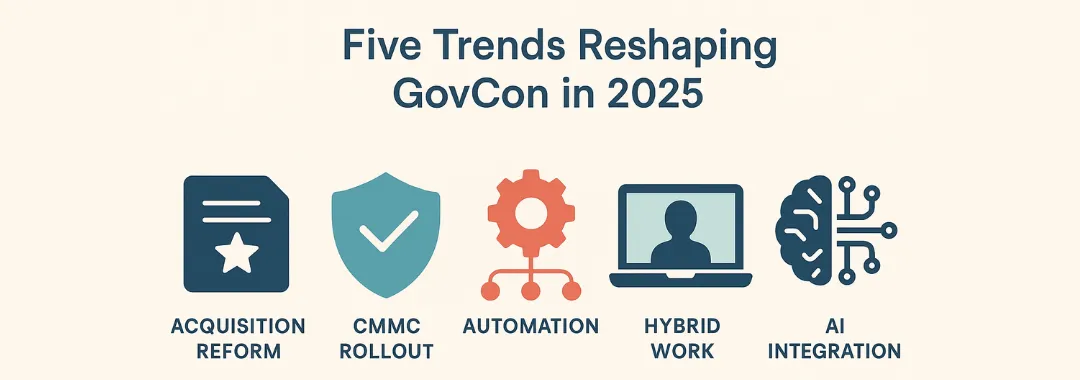
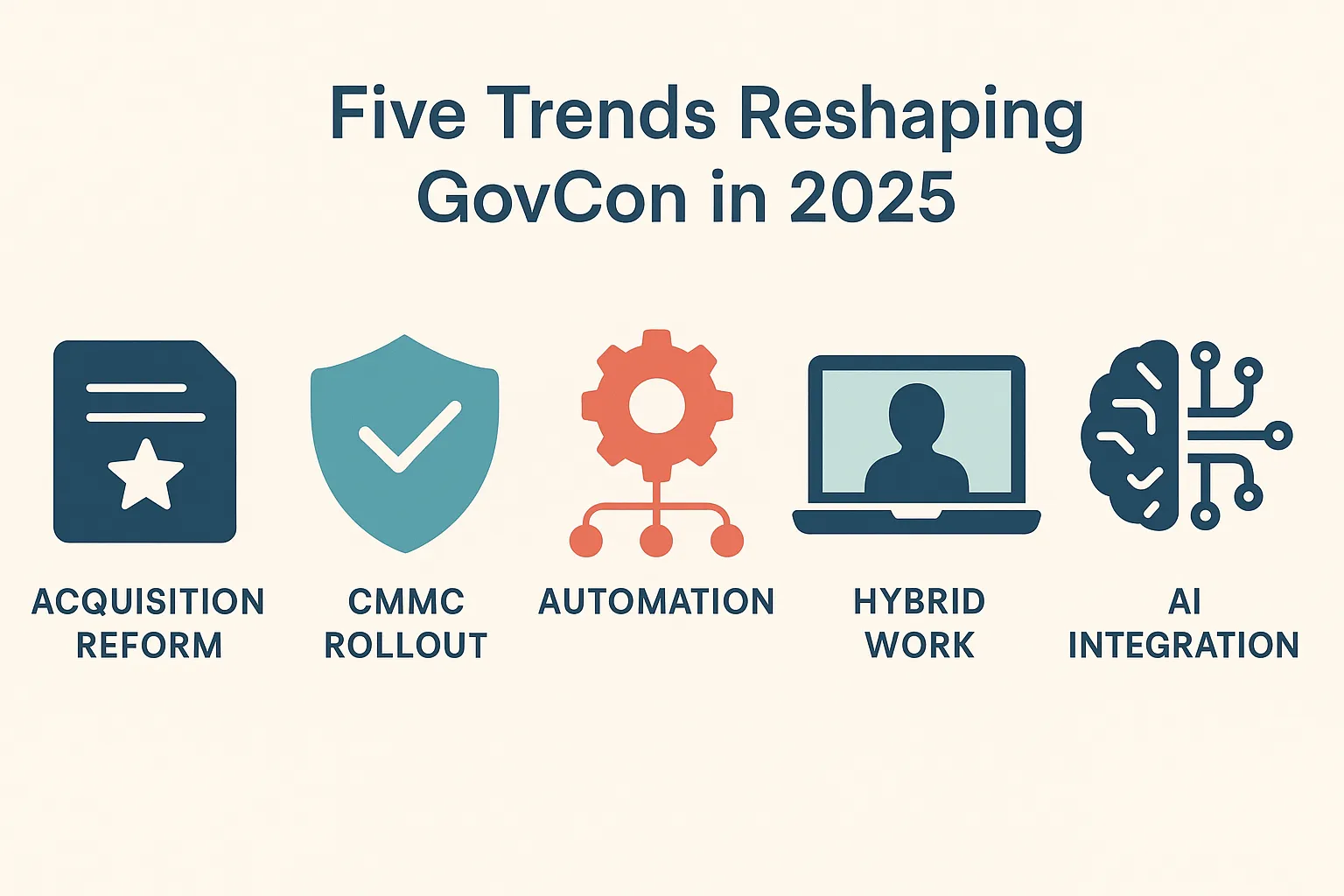
This article unpacks five macro-level trends that are redefining how federal contractors must operate — and what leaders must do to stay ahead.
-
DoD Acquisition Reform Is Accelerating — and Raising the Bar
The Department of Defense is moving faster than many expected. Efforts like the Adaptive Acquisition Framework, initiatives from the Chief Digital and AI Office (CDAO), and Other Transaction Authorities (OTAs) are pushing procurement into a more agile, software-informed model.
Where once the challenge was navigating complexity, now it’s keeping pace with speed and iteration.
What’s Changing:
- More “rapid acquisitions” and prototype pathways
- Demand for greater real-time program transparency
- Contracts tied to agile sprints and continuous delivery models
- Emphasis on mission outcomes over paper compliance
Executive Takeaway:
Agility and transparency are no longer buzzwords — they’re contract requirements. If your internal systems can’t support fast response, modular execution, and integrated reporting, you risk being left behind.
This means investing in not just BD and capture, but also contract operations, program agility, and cross-departmental coordination.
-
The CMMC Rollout Is Forcing a Rethink of Data Ownership and Internal Controls
Cybersecurity Maturity Model Certification (CMMC) has moved from theoretical to operational. CMMC 2.0 is already showing up in DoD solicitations, and primes are being asked to certify their own posture — and that of their subcontractors.
This isn’t just about IT policies or document storage — it’s about control over your business processes, from contract documentation to personnel roles.
What’s Changing:
- Mandatory certification for certain DoD work
- Scrutiny of workflows that touch Controlled Unclassified Information (CUI)
- Emphasis on zero trust, logging, and data residency
- Liability extends to primes managing subcontractor compliance
Executive Takeaway:
You can’t just “delegate” CMMC to IT. Business leadership must ensure that operational systems — including BD, contracts, PM, and finance — are structured to meet these requirements.
This may mean rethinking:
- Where and how contract documents are stored
- Who has access to what and when
- Whether siloed tools (e.g., file shares, local drives) create risk
- How business processes document compliance by default
Leaders who bake security into operations will have a competitive edge.
-
Automation Is No Longer Optional — It’s Expected
Ten years ago, automation was a differentiator. Today, it’s a baseline expectation from both customers and talent. The availability of AI that can be applied in practical ways is driving a new competitive baseline. Repetitive tasks, manual tracking, redundant data entry — they don’t just slow you down, they signal inefficiency to both your federal clients and your future workforce.
The challenge isn’t whether to automate — it’s how to do it across your entire organization, not just in isolated departments.
What’s Changing:
- AI is being applied to internal systems to dramatically improve productivity
- FAR and DFARS compliance demands real-time tracking and version control
- Invoicing and funding updates must be accurate and auditable
- Audit logs are expected to be system-generated, not manually assembled
- Proposal teams are under pressure to deliver faster and with fewer errors
Executive Takeaway:
C-level leaders must drive a shift from “automation as a tool” to automation as strategy. This means:
- Operationalizing business logic into workflows
- Implementing the use of AI on the outside, aka ChatGPT, and the inside to automate your processes
- Eliminating redundant systems that require manual reconciliation
- Reallocating human effort to oversight, decision-making, and collaboration
- Measuring automation not by cost savings alone, but by agility, visibility, and scale
True automation is cross-functional. It doesn’t just make tasks easier — it makes the business stronger.
-
Hybrid Work Is Permanent — and It Demands Systemic Coordination
The return-to-office narrative didn’t play out as expected. In GovCon, as in other sectors, hybrid work has become the norm. Program managers, contract admins, BD teams, and analysts are no longer under one roof — and many never will be again.
This fundamentally changes how coordination, visibility, and compliance must be managed.
What’s Changing:
- Teams are distributed across states, time zones, and security clearances
- Informal syncs and tribal knowledge are less accessible
- Email and spreadsheets can no longer support real-time coordination
- Customers expect answers, updates, and deliverables faster than ever
Executive Takeaway:
Hybrid work requires systems that don’t rely on hallway conversations or shared drives. The operating model must be digitally native, with:
- Role-based visibility into workstreams and contract data
- Shared access to live records — not versioned files
- Cross-functional dashboards that provide real-time status
- Secure collaboration that’s FedRAMP- and CMMC-aligned
Executives must stop thinking about “remote work policies” and start building remote-native operations.
-
AI Is Redefining How Work Gets Done — and Who Does It
The AI wave isn’t coming — it’s here. But for GovCon leaders, the real disruption isn’t just about language models or futuristic scenarios. It’s about how AI will become embedded in business systems — and what that means for talent, compliance, and scalability.
From document analysis to workflow triggers to data extraction, AI is moving from suggestion to execution.
What’s Changing:
- AI is now capable of reading and understanding federal contracts
- Tasks like extracting FAR clauses, tracking CLINs, and routing approvals are being automated
- Federal agencies themselves are adopting AI — and expect contractors to do the same
- Human roles are shifting from execution to review and oversight
Executive Takeaway:
AI is not a side project. It’s a force multiplier — but only for businesses that are ready to integrate it into their day-to-day execution.
To lead in an AI-ready GovCon organization, executives should:
- Identify high-volume, rules-based tasks that can be delegated to AI
- Ensure systems are structured enough to support AI action (not just analysis)
- Redesign workflows for human + AI collaboration
- Build trust through explainability, audit trails, and governance
Those who treat AI as a partner — not a replacement — will move faster, reduce errors, and scale smarter.
What Does All This Mean for the C-Suite?
These trends aren’t theoretical. They’re operational. And they demand a new kind of leadership.
The old view:
“Compliance, contracting, and program execution are handled by the teams — I just need to keep the business growing.”
The new view:
“How we structure, automate, and integrate the business is how we grow.”
Strategic leadership in GovCon now requires owning the operating model — not just the financials or capture pipeline. It means asking:
- Do we have systems that scale with complexity and speed?
- Are our teams operating from a shared source of truth — or across silos?
- Is our compliance structure embedded in the process — or bolted on after?
- Are we building a workforce augmented by AI — or burdened by manual work?
- Can we respond to customer demands in hours — or does it still take weeks?
The Next Phase of GovCon Leadership
Federal contracting has always been a high-stakes, high-compliance business. That hasn’t changed.
What has changed is how work gets done — and the expectation that businesses will operate with the same agility, intelligence, and transparency that government customers are adopting themselves.
To thrive in this next era, C-level leaders must become architects of operational intelligence. That means building organizations where compliance is strategic, automation is systemic, collaboration is seamless, and AI isn’t just a tool — it’s a teammate.
Because in this new landscape, it’s not just about who can win the contract.
It’s about who can execute — with speed, precision, and confidence.