
In federal contracting, complexity is constant — and it’s been putting pressure on contract teams for years. Talent gaps, rising compliance demands, and siloed systems have made traditional models unsustainable.
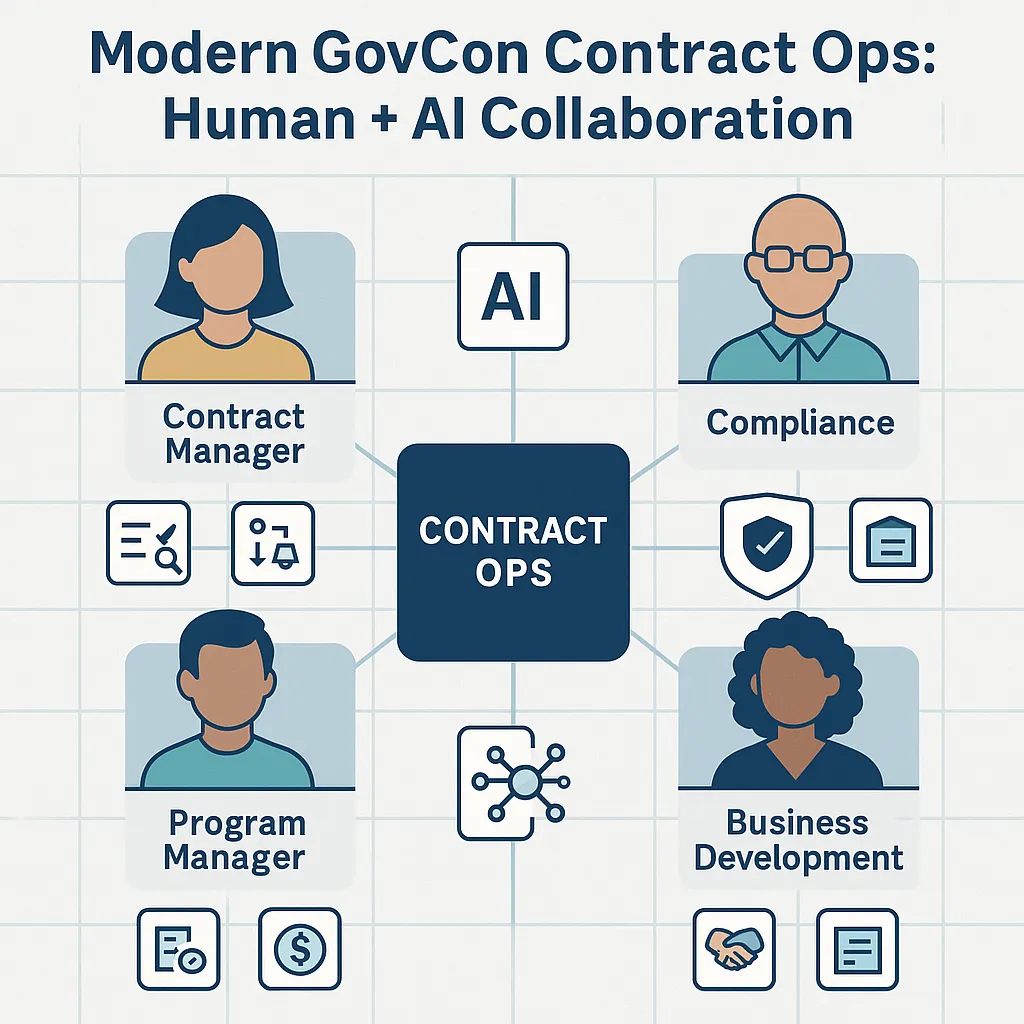
Now, a shift is happening — not just in tools, but in how GovCon teams are organized and empowered. A new function is emerging: Contract Operations — a team that unifies roles, automates execution, and aligns the entire organization around contract delivery.
What’s different today is that we finally have the technology to make it work. AI and work automation are no longer futuristic concepts — they’re embedded in the systems teams use every day, transforming how contract work gets done.
This article explores the rise of Contract Ops, the roles and skills behind it, and how AI makes it possible to modernize without more effort, cost, or disruption.
The Legacy Model: Functional but Fractured
Historically, contract teams operated in silos. The contract manager was called in at award or escalation. Data lived in spreadsheets, emails, and disconnected systems. Contract documents were often tightly protected by contracts. Approvals were routed manually. Deliverables and funding updates were tracked with human memory or static logs.
This model led to:
- Limited access to information by non-contract people
- Missed deadlines and funding thresholds
- Repetitive data entry and document reconciliation
- Inconsistent compliance tracking
- Reactive coordination across departments
While the legacy approach ensured minimum compliance, it was inefficient and unsustainable at scale.
The Shift: Contracting as an Operational Discipline
Forward-leaning GovCon organizations are flipping the paradigm. They view contracts not as static documents, but as operational engines — driving delivery, compliance, and financial outcomes across the business.
This shift reframes the contract team as an orchestrator: responsible for coordinating workflows, aligning stakeholders, and ensuring the system reflects the real-world state of each contract. It requires more than legal expertise — it demands operational fluency, systems thinking, and collaboration across business units.
And that’s where Contract Ops comes in.
What Is Contract Ops?
Think of Contract Ops the way Revenue Ops transformed sales — as the connective tissue that aligns people, processes, and platforms for better execution.
It’s not a replacement for contract managers or compliance leads. Instead, it’s a dedicated function focused on:
- Designing and monitoring contract workflows
- Redesigning processes to eliminate manual effort, automate work, and drive efficiency and consistency
- Enabling real-time reporting and portfolio visibility
- Managing cross-functional coordination post-award
- Driving system configuration and usage
- Ensuring data quality and consistency
- Monitoring alerts and process triggers
In organizations with modern contract systems, this role often serves as the administrator or workflow owner — the person who ensures the system works the way the organization needs it to.
Key Roles and Skills on the Modern Team
As GovCon contract teams modernize, the core roles are evolving. Traditional responsibilities remain important — but they’re increasingly supported by AI, automation, workflows, analytics, and integrated systems. Here’s how the skill mix is changing:
Contract Manager
- Clause interpretation and negotiation strategy
- Oversight of automated or AI-generated records
- Managing escalations and compliance exceptions
Contract Administrator
- Managing workflows and approvals
- Setting up alerts and notifications
- Ensuring document consistency and version control
Program Manager
- Monitoring deliverables and funding balances
- Participating in contract reviews and approvals
- Collaborating with finance and compliance teams
Compliance Analyst
- Tracking regulatory deadlines and certificate expirations
- Investigating flagged risks and anomalies
- Maintaining audit readiness through real-time systems
Business Development
- Tracking transition activities and sub agreements
- Participating in clause negotiations and risk assessments
- Staying aligned with contract execution
Contract Ops / System Owner
- Configuring workflows and dashboards
- Managing user access and permissions
- Supporting change management and adoption
- Monitoring system health and process alignment
Why the Change Couldn’t Wait Any Longer
For years, federal contract teams have been under mounting pressure. Seasoned professionals are retiring faster than they can be replaced. Compliance requirements are stacking up. And cross-functional teams — BD, Finance, PM, Compliance — need more timely access to contract data than ever before.
These challenges have been building slowly but steadily. The signs were all there: too many emails, too many missed deadlines, too much rework. The old model was fraying — and something had to give.
The Enabler: AI and Automation at the Right Moment
What changed wasn’t just the pressure — it was the technology.
Applied AI and embedded automation are now powerful enough to do the hard part of contract operations. They don’t just analyze or advise. They do the work: ingesting documents, updating records, triggering workflows, and keeping teams aligned.
And that changes the equation.
Modernizing your contract operations used to mean more effort, more disruption, and more investment. Now, it’s the opposite. With the right system, quality Contract Ops gets easier to build — and easier to sustain. Your team can work less, to accomplish more.
Just like Zoom hit its stride when the world needed it most, AI for GovCon is arriving right on time — ready to solve the problems that have been waiting years for a solution.
What Changes When AI Does the Work
When AI is embedded inside your contracting system of record — not bolted on externally — the shift isn’t just faster execution. It’s a fundamental change in what becomes possible to manage, and how little effort is now required.
Clause Management That Maintains Itself
AI-powered ingestion now extracts FAR and DFARS clauses automatically and updates your master clause library dynamically. As new contracts come in, the library grows — no separate list management or version tracking needed.
True CLIN-Level Management — Without the Headache
AI now extracts CLINs, SLINs, and ELINs and populates the contract structure instantly. This makes it much easier for contract to manage at the CLIN level.
From CLINs to Burns — Full Funding Visibility
Modern systems can ingest invoice funding data and tie it back to individual CLINs, enabling real-time burn tracking — by contract or by CLIN. AI-generated alerts at the CLIN level help teams stay ahead of funding thresholds without additional overhead.
How to Build a Modern Contract Ops Function — Powered by the Right Tools
You don’t need to overhaul everything. The foundation is already there — the pressure has clarified the need, and the technology makes the path easier than ever.
Here’s how to start:
- Map your contract touchpoints
- Assign a Contract Ops champion
- Upgrade your system to support automation and AI
- Embed visibility and accountability
- Automate one layer at a time
The Payoff: Do Less. Accomplish More.
This isn’t a story about more work. It’s about better systems doing the work for you — so your people can focus where it matters most.
With Contract Ops and AI working together:
- Deadlines stop slipping
- Funding visibility improves
- Reviews and audits get easier
- Coordination becomes natural
- And your team spends more time thinking, and less time chasing
Final Thought
For GovCon leaders, this is the opportunity to step back — and step up.
You now have the leverage to transform your contracts function into a high-performing, system-driven capability. You don’t need to add headcount. You don’t need to rip everything out. You just need to activate what’s ready and let automation and AI do what they were built to do.
Contract work will never be simple — but getting it done well has never been easier.
See how R3 Contract Management R3 Contract Management for GovCon enables you to make the shift to contract operations.